
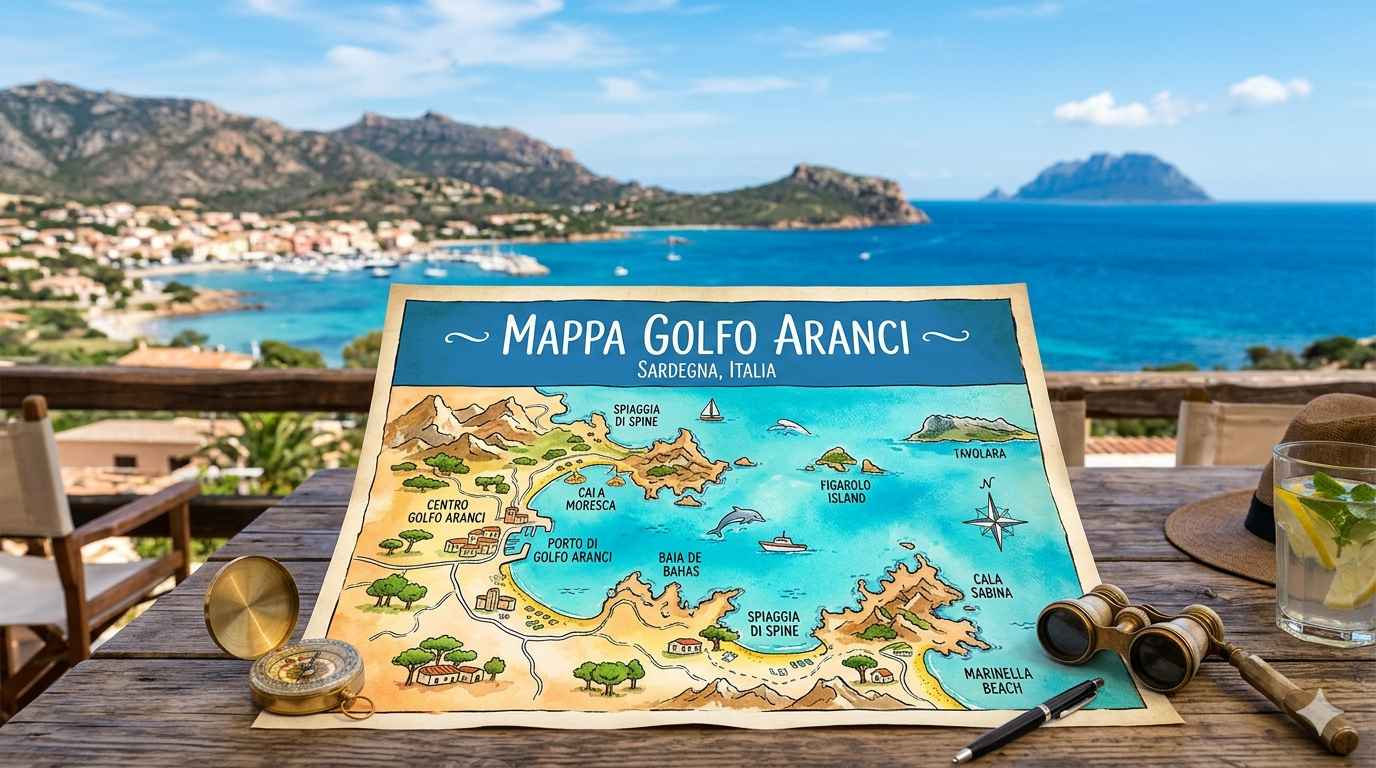
Golfo Aranci Map and Map: The complete route planner for your holiday
Welcome to the definitive map guide to Golfo Aranci. If you are looking for a street directory detailed, a map tourism or you simply want to understand how find the most important beaches, restaurants and ports, this article is for you. Published by Alpamarine, your reference for boat hire and excursions in north-eastern Sardinia, this post will provide you with a map conceptual but also practical guidance for Aranci Gulf. You will learn how to read the territory, how to move between points of interest and how best to plan your holiday.How to find the best beaches using the Golfo Aranci road map?
1. Where is Golfo Aranci? A mental map of the north-east coast
Before going into the street directory proper, it is useful to have an overview. Aranci Gulf is located on the north-east coast of Sardinia, a few kilometres from Olbia and Porto Rotondo. If you look at a map of Sardinia, you immediately spot it thanks to its natural gulf that juts out towards the island of Tavolara and the La Maddalena archipelago. Its location is strategic: it is the last municipality before taking the road to Palau, from where the ferries to La Maddalena depart. For those travelling with Alpamarine, This means quick access to both the crystal-clear waters of the Costa Smeralda and the wilder trails of Capo Figari.
On map regional, Aranci Gulf appears as a small promontory that closes the large Gulf of Olbia to the north. The municipal territory is relatively compact: to the west it borders Olbia, to the south the sea of the gulf, to the east and north it faces the open sea towards La Maddalena. The height above sea level is minimal in the built-up area (a few metres) while it rises rapidly towards Capo Figari, where it reaches 200 metres. This conformation means that many roads have a considerable slope, especially those that climb towards the viewpoints. Keep this in mind when planning journeys on foot or by bicycle.
A curiosity that few people know: the name Aranci Gulf derives from the presence of ancient citrus groves that grew luxuriantly in this area thanks to the mild climate and fresh water from the springs. Today, those citrus groves have almost disappeared, but the name has remained to testify to an agricultural past that merges with a maritime vocation. On map of golfo aranci historical, traces of these ancient cultivated lands can still be found today, especially in the area south of the centre, towards the hamlet of Marinella. Knowing these little stories will help you read the area with different eyes when you walk its streets.
2. Getting your bearings with a map of Golfo Aranci: centre, port and surroundings
Take now an ideal map of the town. The beating heart is the seafront promenade, which develops in a semicircle around the marina. The two main streets are Via Roma and Via della Libertà, which run along the sea and meet in the main square, where there are bars, ice-cream parlours and the church of San Giuseppe. If you are looking for Alpamarine, our starting point for excursions is in this very area: we are on the main pier, easily recognisable by our moored boats. On your map mental, mark this point as “north”, because the whole country fans out from here inland.
Proceeding inland, Via Gramsci and Via Garibaldi will take you to the residential district, where most of the shops grocery stores, pharmacies and post offices. Further south, past the railway overpass, you enter the Marinella area, a quieter hamlet with low houses and small beaches frequented mainly by local families. On map of golfo aranci, Marinella appears as a sort of “second village” separated from the main centre by about 2 km of very scenic coastal road. It is a perfect area for those seeking silence and who want to be close to the sea without the chaos of the port.
North of the centre, however, the road begins to climb towards Cape Figari and the beach of Cala Moresca. This stretch is less urbanised and wilder: the roads are narrower, often without pavements, and wind their way through Mediterranean scrub and vineyards. A map detailed will help you not to get lost, as forks are not always perfectly signposted. Our recommendation: download an offline map to your phone before venturing into this area, or rely on the directions in the following paragraphs. Gulf of Oranges is small, but its hilly roads can be deceiving.
3. What are the starting points for Alpamarine excursions on the map?
We of Alpamarine we are proud to operate from the port of Aranci Gulf, one of the best equipped marinas in Sardinia. On map, our starting point is marked at the northern end of the promenade, exactly opposite the old railway yard (now disused, but easily recognisable by its exposed stone building). For find our ticket office, look for the blue and white “Alpamarine - Charter & Tours” sign at Molo Vespucci. Parking is possible in the vicinity, either in the pay car park at the harbour (recommended in high season) or along the side streets to the north of the square, where space can often be found.
From our base, boats set sail every morning for the most beautiful destinations: the island of Figarolo, Cala Moresca, Cape Figari, and, of course, the search for dolphins. On map Of the tours we provide on board, we have mapped out the typical routes: first you sail south along the coast to exit the gulf, then head east to the island of Tavolara, or north to the promontory of Capo Figari. In less than 20 minutes of sailing you are already in deep, crystal-clear waters, far from the crowds. This is the advantage of starting from Aranci GulfThe central location reduces transfer times and maximises time for swimming and snorkelling.
If, on the other hand, you have booked a charter boat without a skipper (with us it is possible, if you have a licence), the embarkation point is the same. We will give you a map detailed navigation with waypoints of the safest and most beautiful coves. Remember: the port of Aranci Gulf has all services: fuel, water, electricity, and nearby bars and restaurants where you can have breakfast before set sail. For those arriving by car, our advice is to park at the car park in Via Marconi and then walk to the pier (5 minutes). Follow the signs for “Tourist Boats” on the road signs, and you won't go wrong.
4. How to find the best beaches in Golfo Aranci?
Let us now see how to use the street directory for find the most beautiful beaches in Aranci Gulf and the surrounding area. The town's main beach is the Spiaggia della Marinella, which can be easily reached: from the central square, take Via Garibaldi in a southerly direction, pass the flyover and after about 1.5 km you will find the beach entrance on the right. The road is paved and well signposted. This beach is well equipped, with bathing establishments, parking (for a fee in season) and a small kiosk. It is an ideal choice for families with small children because the water is shallow for tens of metres and the seabed is sandy.
For those looking for something wilder, the goal is Cala Moresca. Reaching it by car is possible but requires attention. On map of golfo aranci, you will find the road that from Via della Libertà (at the port) climbs northwest, becoming Via Punta Semaforo. Follow this road for about 2 km, always uphill, until you see a dirt car park on the left. From there a hiking trail 15-minute walk down to the cove. Beware: the road is narrow, with some hairpin bends, and in high season the car park fills up very early (by 9am). Our recommendation is to arrive early or, better still, to reach Cala Moresca by sea on one of our excursions.
Another lesser-known but easily accessible beach is Cala Sabina, on the island of Tavolara. It cannot be reached by land, because Tavolara is only accessible by sea. However, from the port of Aranci Gulf ferries and taxi boats depart and take you directly to the beach in 20 minutes. On your map, mark the taxi boat pier at the south end of the harbour (after the harbourmaster's office). Prices are reasonable and the service is frequent in summer. If you prefer to organise a full day, Alpamarine offers a tour that includes Cala Sabina, Cala Moresca and the search for dolphins, taking away all logistical worries.
5. Where to park? Driving directions and useful routes
Parking at Aranci Gulf in high season can be a challenge, but knowing the routes right is easily solved. The most critical area is the waterfront and harbour, where parking spaces are limited and charged for (hourly or daily rates). Our preferred solution, and the one we recommend to customers of Alpamarine, is the interchange car park in Via Marconi, about 500 metres from the centre. On map road, it is indicated with a big “P”. It is free, guarded and a free shuttle bus leaves from there to the harbour in 5 minutes (every 15 minutes in summer). Alternatively, you can go on foot: a pleasant 10-minute walk along a tree-lined street.
If you prefer to park close to the sea, look for spaces along Viale dei Tramonti (the road that runs alongside Marinella beach). Here the parking spaces are free but much sought after: the ideal is to arrive before 9.30am. Another less frequented area is around the municipal cemetery (via della Libertà, north side): there are several free parking spaces and from there it is a five-minute walk to the port. The only caution: avoid leaving valuables in sight in your car, as in any tourist resort. For those staying in one of the hotels in the centre, many offer reserved parking: always ask at the hotel before arriving.
For those arriving by camper van or caravan, Aranci Gulf offers an equipped parking area in Via del Porto Vecchio, near the former railway station. It is chargeable, but has all services (drainage, water, electricity) and is a stone's throw from the sea. On map tourist, is marked with the mobile home symbol. Remember that in the old town centre and along the seafront, parking for motorhomes is forbidden and strictly controlled. One last tip: during summer events (such as the famous “Festa del Mare” in August), many car parks are reserved or closed to traffic. Keep an eye on the signs road and the municipal website for updates.
6. What are the main shops, restaurants and services on the map?
Orienting oneself to Aranci Gulf also means knowing where find essential services. On map of golfo aranci, i shops grocery stores are mainly concentrated on Corso Roma (the main street connecting the square to the port). Here you will find a butcher's shop, a bakery, a greengrocer's and two small to medium-sized supermarkets (Conad and Eurospin are a little further along Via Garibaldi). For typical Sardinian products, on the other hand, we recommend a visit to “Sa Mesa”, a small speciality shop in Via Amendola, a stone's throw from our ticket office Alpamarine. Here you can buy cheese, salami, carasau bread and bottles of vermentino to take to the boat.
Restaurants and bars are concentrated along the promenade and in the squares. On map ideal, the “movida” area is between Piazza Terzo Millennio and Piazza dei Mille. Here you will find places like “Il Pescatore” (fresh fish), “La Perla” (pizza and Sardinian cuisine) and the “Bar Centrale” for aperitifs. If you are looking for a romantic dinner with a view of the harbour, go to the “Golfo Aranci” restaurant on Molo Vespucci. For the more informal, the “friggitorie” along the quay offer fish fried for walking. As far as services are concerned: the pharmacy is at Corso Roma 45, the post office is at Via Garibaldi 12, the first aid station is at Via Madonna di Lourdes (follow the signs for the hospital).
Finally, for those who need beach equipment or technical items for the snorkelling, In Via della Libertà there is a small diving shop selling masks, flippers and wetsuits. If, on the other hand, you have forgotten sun cream or a hat, the kiosks along the promenade (open until late) will solve the problem. A tip from Alpamarinebefore setting sail for your excursion, drop by the market in Via Marconi to stock up on water and snacks. Prices are lower than at the harbour kiosks and there is more choice. On your map mental, mark this market as a “must stop”.
7. How do I get to Golfo Aranci by car, bus or boat?
Aranci Gulf is well connected to the rest of Sardinia and Italy. If arriving by car, the main road is the SS 125 Orientale Sarda. From Olbia airport (Costa Smeralda), follow the signs for “Olbia centro”, then “Palau” and finally “Golfo Aranci”. The journey time is about 25 minutes on a state road in good condition. In high season, the stretch between Olbia and Golfo Aranci can be congested, especially at weekends. On routes Alternatively, there is a more scenic but slower coastal road (SP 82) from Porto Rotondo: this is only recommended if you are not in a hurry and want to enjoy the scenery. On map road, is the road that runs along the beaches of Pittulongu and Marinella.
Those travelling by bus can use the services of ARST (regional bus lines) that connect OlbiA (the Olbia bus station) with Golfo Aranci several times a day. Line 514 (Olbia-Golfo Aranci) is the most frequent, running about every 30-60 minutes in summer. The main stop in Golfo Aranci is right in front of the port, in Piazza Terzo Millennio. For up-to-date timetables, consult the ARST website or the Tuttocittà app (discussed in section 9). Tickets can be purchased on board or in tobacconists' shops. A convenient alternative is the private shuttle service that many hotels organise on request.
Finally, a curiosity: Aranci Gulf has a railway station (Olbia-Golfo Aranci line), but the service is limited and does not always coincide with ferry times. If you arrive by ship at the port of Olbia, you can take a taxi (cost about 30-40 euro) or the bus. For those arriving by sailboat or yacht, the port of Aranci Gulf is equipped with guest berths (contact the harbourmaster's office for details). We of Alpamarine we are available to advise you on the best solution according to your needs: write us an e-mail before your trip, and we will gladly help you plan your arrival.
8. Which walking and cycling routes to follow according to the map?
Aranci Gulf is a town that can be explored very well on foot or by bicycle, especially due to its flatness in the centre. On map of the municipality are reported several routes pedestrian and cycle paths. The most beautiful is the seafront promenade: from the central square to the Marinella Beach, there are about 2 km of flat promenade with benches and viewpoints. In summer, the promenade is closed to traffic in the evenings (from 19:00 to 24:00), becoming a pleasant pedestrian zone where you can stroll among stalls and street performers. This is the best way to immerse yourself in the atmosphere of the town.
For trekking lovers, the loop route of Punta Semaforo (about 5 km) starts from Via della Libertà and goes up to the promontory of Cape Figari. The path is well marked with red-white markers and offers breathtaking views of the entire gulf and the island of Tavolara. Caution: the height difference is about 200 metres, so a minimum of training is required. Bring water and trainers. On map tourist, you will find this route marked as the “Lighthouse Path”. The ascent takes about 45 minutes, the descent 30. We of Alpamarine we recommend it to our customers who want an active day before or after the boat trip.
For cyclists, the cycle path connecting Aranci Gulf in Olbia is nearing completion, but a very nice section is already accessible: from Marinella to Porto Rotondo (approx. 7 km) on a reserved, flat road. You can rent bicycles at various places in the village, for example from “Bike & Go” in Via Roma. On map cycle path, the coastal route is marked with blue lines. Remember that some hilly roads (such as those to Cala Moresca) are not recommended for inexperienced cyclists because of the gradients and traffic. Better to stay on the coastal plain or rely on guided tours. For those who want to combine bike and boat, Alpamarine offers the possibility of loading the bicycles on board some rubber dinghies (on request), so you can explore the coves and then take a bike ride inland.
Key Points to Remember
-
Aranci Gulf is located on the north-east coast of Sardinia, 20 minutes from Olbia and well connected via the SS 125.
-
La map of the centre is simple: the waterfront (Via Roma and Via della Libertà) is the hub, with its harbour, bars and restaurants.
-
For find Alpamarine, look for Molo Vespucci at the north end of the harbour: our excursions depart from there.
-
The best car parks are the interchange in Via Marconi (free with shuttle bus) and the places along Viale dei Tramonti.
-
The main beaches (Marinella) are easily reached by car; Cala Moresca requires a hilly road and a short trek.
-
The whole city and Google Maps offline are the most useful digital tools for finding your way around without the unexpected.
-
La map of the municipality indicates pedestrian (promenade) and bicycle routes (up to Porto Rotondo).
-
I shops and essential services are concentrated on Corso Roma and Via Garibaldi.
-
For those arriving by ship or plane, buses and shuttles regularly connect Olbia to Aranci Gulf.
How useful was this post?
Click on a star to rate it!
Average rating 0 / 5. Vote count: 0
No votes so far! Be the first to rate this post.